
Christmas Diagnosis
Dr. Luke gave us a clear message and Phillips Brooks gave it to us in song.
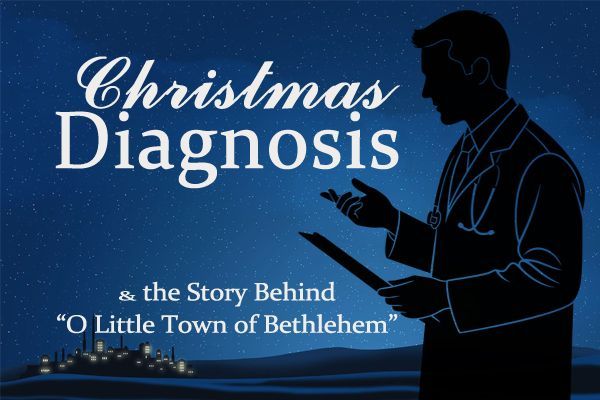
The best diagnosis of Christmas was given by a doctor long ago. The doctor is Luke. His diagnosis is found in the second chapter of his inspired record, known to us as the Gospel according to Luke. In verse eleven, we have the message:
For unto you is born this day in the city of David a Saviour which is Christ the Lord.
Note how clear is the doctor's diagnosis:
"Unto you" - that is Personal
"This day" - that is Present
"A Saviour" - that is Precious
We must remember, there is all the difference in the world between Christmas and Christ. Millions make a holiday over Christmas, and often only a mockery over Christ. Too often, Christ is cruelly crowded out of the special day which is intended as a day to remember Him. Holiness is hidden underneath a pile of holly. The wreath is hung higher than the Cross, and worst of all, the Precious Saviour all too often is supplanted by Santa Claus.
But without Christ, there can be no true Christmas. Without Him there is nothing about which to sing, or anything over which to rejoice. Outward merriment, too, often becomes inward mockery to the starved soul. It is time for all to turn back to the old prescription of Doctor Luke. Let us meditate upon his words:
Unto you ...
This is a personal message, and there should be no evasion or denial. What have you done with the Lord Jesus Christ? Have you received Him? Romans 10:13 says: For whosoever shall call upon the name of the Lord shall be saved. Salvation is personal. It is a gift to you.
This day...
Yes, this very moment, God is offering you the greatest Christmas gift of all, His dear Son! Thanks be unto God for His unspeakable Gift! (2 Cor. 9:15)
A Saviour
This is Christ, the precious one who went to the cruel cross for all of us. Because of His grace, and His atoning death on the cross, all who receive Him become "new creatures in Christ Jesus" (2 Corinthians 5:17).
Mabel-Ruth Jackson wrote, that on one Christmas Eve long ago, an American minister rode horseback into the hills of the Holy Land. He stopped his horse in the very fields where the shepherds watched their flocks by night. He looked about him in revered silence.
Down below he saw the dark streets of a little town called Bethlehem. Above him he saw the same stars shining in the dark blue sky that shone there the night the baby Jesus was born. Though the air was cold, Phillips Brooks found it hard to leave. He was deeply moved.
The scene Dr. Brooks had observed in Palestine could not be erased from his mind. He returned to the United States and transposed the vision into a haunting poem.
Lewis Redner, organist in Dr. Brooks' church, was inspired by the poem to set the words to music.
Many others have stood and observed the sacred scene, but only Dr. Phillips Brooks resolved to give the scene to the world. "O Little Town of Bethlehem" has become one of the best-loved Christmas carols.
O little town of Bethlehem,
how still we see thee lie!
Above thy deep and dreamless sleep
the silent stars go by.
Yet in thy dark streets shineth
the everlasting light;
the hopes and fears of all the years
are met in thee tonight.
For Christ is born of Mary;
and, gathered all above,
while mortals sleep, the angels keep
their watch of wond'ring love.
O morning stars, together
proclaim the holy birth,
and praises sing to God the King,
and peace to men on earth.
How silently, how silently,
the wondrous gift is giv'n!
So God imparts to human hearts
the blessings of His heav'n.
No ear may hear His coming,
but in this world of sin,
where meek souls will receive Him still,
the dear Christ enters in.
O holy Child of Bethlehem,
descend to us, we pray;
cast out our sin and enter in;
be born in us today.
We hear the Christmas angels,
the great glad tidings tell;
O come to us, abide with us,
our Lord Emmanuel!
The Voice in the Wilderness